
Over-apologizing + Hedging • ep. 155
Over-apologizing + Hedging • ep. 155
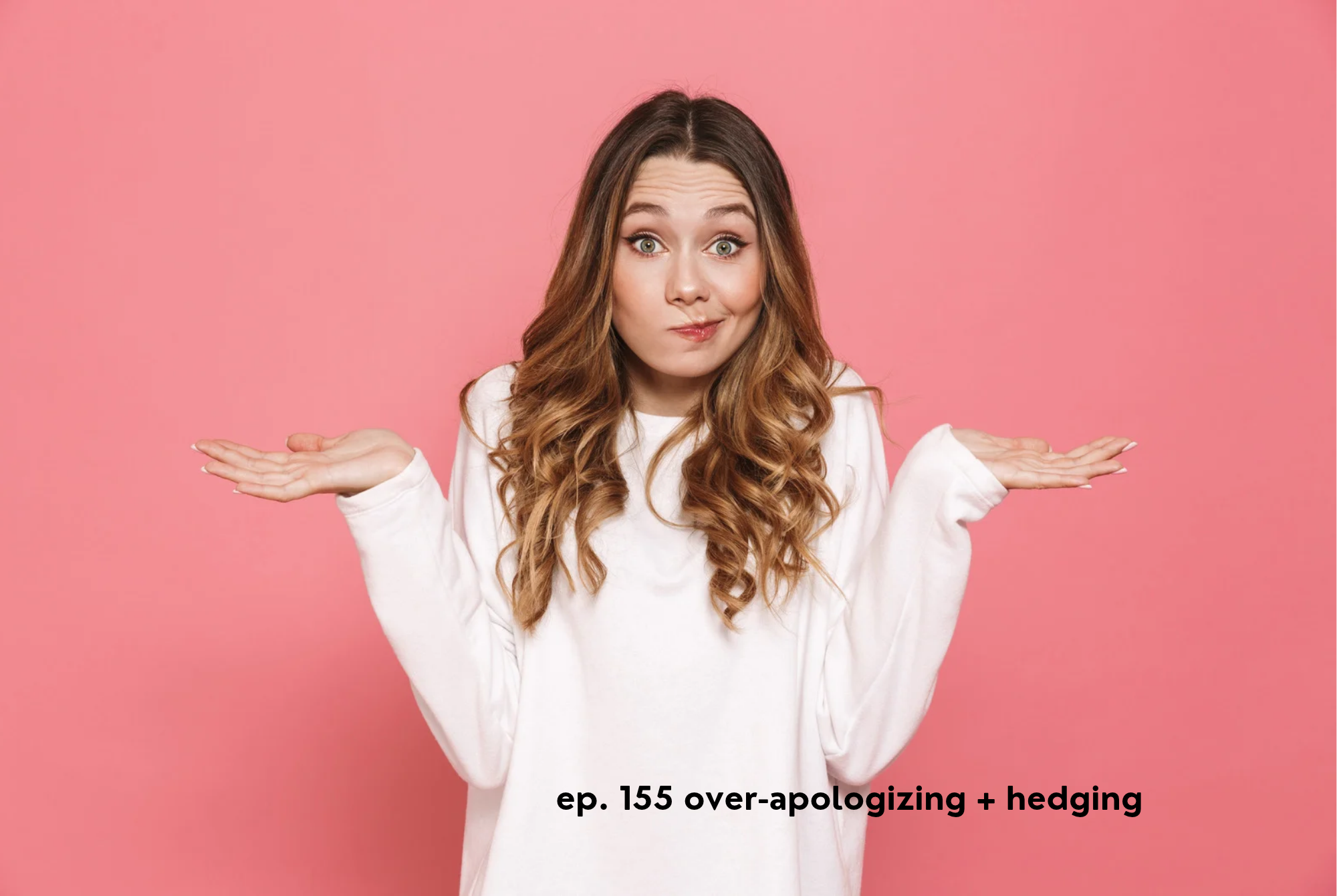
so over over-apologizing
So when I was younger, I had a habit of over-apologizing. Of course I made mistakes and said sorry, but I would also say sorry for things that didn’t necessarily require an apology. And I would do it a lot.
I’d apologize for asking for a drink while at my friend’s house, as if it was so selfish of me to be thirsty. I’d apologize for tying my shoes differently than others do, even though my method still worked. I’d apologize when asking for help with a math problem, as if needing help was wrong. I specifically remember, I was probably in middle school, my friend pointed out that I kept saying sorry for things, but didn’t need to. You know how I replied? Sorry. I was sorry for being sorry all of the time.
I don’t think over-apologizing was something I was taught to do. I probably just picked up on it from hearing people around me do it. And I’ve heard that over-apologizing is common for folks like me with ADHD (more in ep. 112). But it’s also something girls and women have a tendency to do. Maybe you do, too.
With time, I learned to say sorry less, only when actually needed. But I also had another habit that needed breaking–hedging.
had it with hedging
This may not be a term you’re familiar with, but when I describe it, I think you’ll know exactly what it is. Hedging is when you soften a statement to make yourself sound less-intimidating. For example:
When asking your science teacher for clarification on homework, you start by saying, This may be a dumb question, but …
Or when working on a history group project, you remind your classmates about an important fact by prefacing with, I may be wrong, but …
Or when you’re planning an event with your club, you explain your idea for a wall poster, but end by saying, Does that make sense?
Any of that sound familiar? Me too, I still catch myself hedging even though I’m aware of it.
Some other phrases often heard with hedging are I kind of thought… like, I kind of thought the pythagorean theorem might work here, I dunno ...
Or the phrase, I guess … like, I guess what it means is Romeo thinks Juliet is the sun because ...
Or a phrase I still use a lot, I just wanted to … like I just wanted to check if you were able to come, no worries if not
Or the phrase, I feel like … as in, I feel like this could be good in the long run ...
Do you hear how beginning with those phrases makes me sound like I'm doubting what I have to say, or I'm trying to tiptoe into the situation, not bug anyone. Does that make sense? (see what I did there?)
Plus there are some apology hedges, too: Sorry to bother you …, Sorry I know you’re busy …, Sorry is this a bad time?
And please remember I do these things too, okay? So if you feel called out right now, just know you're in really good company. I mean, ask any of your friends, your mom, your aunt. I think all girls and women do this to some type of degree, and we know it, but we also are trying not to do it, but then we don't know how NOT to do it, and so we're kinda just stuck here.
why we do it
We may use hedging phrases to sound polite and appeal to others, but they can make us sound less confident and uncertain. I understand that this is a paradox–girls are taught many contradictions. You need to go for your goals, but remember to put others first. Speak up in class, but not too much or you’ll seem like a know-it-all. Ask for what you want, but don’t be too bossy.
So we over-apologize because we don’t want to inconvenience anyone. We hedge because we don’t want to seem self-centered. We anticipate someone’s reaction if we actually said what we meant. We may have learned to do these things to protect ourselves because of a past experience. And so we go through our daily life apologizing for how we show up in the world, and minimizing our ideas so we take up less space. And the more we over-apologize and hedge, the less we speak up, the less we try to reach our goals, and the lower our confidence sinks.
You don’t need to be sorry for who you are. Obviously, take responsibility for your actions and apologize when it's actually needed. Aside from that, you don’t need to be sorry all the time. You don’t need to water down what you’re trying to say. You don’t need to shrink for other people’s approval. Okay Steph, so what AM I supposed to do? So glad you asked.
assert yourself
Let’s talk about how to assert yourself in an unapologetic way.
Instead of saying Sorry to bother you … try Hey can you chat for a minute?
Instead of Sorry I forgot … try Thanks for the reminder!
Instead of Do you think we could maybe … try I’d like to … or Could we …
Instead of Sorry I’m late! Try Thanks for waiting for me!
Instead of Sorry it’s not perfect … try I worked really hard and did my best.
Instead of Sorry I interrupted you … try I appreciate your help.
Instead of This may be a dumb question … try just asking your question!
Instead of I may be wrong, but … try just saying what you have to share.
Believe me, these are really hard habits to change. Their paths are carved deep in our brains, so taking an alternate thought route will require lots of practice, and at first it might feel weird. But before you respond, if you can remember to pause first, and think, Do I really need to apologize for this? Probably not. And then for extra credit, you can ask yourself, What’s another way I can say this without minimizing myself? Those two questions will help you shift your over-apologizing and hedging habits into assertiveness and confidence.
The more you practice, the better you’ll get at it, and the better you’ll feel about yourself, too. Remember, you don’t need to be sorry for how you show up in the world. And you don’t need to make yourself smaller or take up less space to earn others’ approval. You are enough. Period.
Resources
If you have a topic suggestion, I’d love to hear from you! Send an email (tweens get the OK from your parents) to [email protected] .
If you have social media already, follow me on Insta, TikTok, or YouTube @empowerfulgirls. I’m not encouraging or endorsing social media, but I’m on there to offer an unfiltered, uplifting alternative to what’s in your feed. Remember to get on the email list for the newsletter!
Also, if you enjoy listening to 10 for Teens + Tweens, I would truly appreciate you telling your friends about this podcast or leaving a review so others can find it and feel uplifted, too! Your support means the world to me!